Why People Take the Rice Purity Test (And Why It’s Still So Popular)
People take the Rice Purity Test for 5 primary reasons: curiosity about their own experiences, self-reflection, entertainment, social comparison with friends, and participation in a long-standing college tradition. The test produces a single score between 0 and 100 — making it fast, shareable, and inherently social.
Why Do People Take the Rice Purity Test?
People take the Rice Purity Test because it answers a question most already have: How do my experiences compare to others?
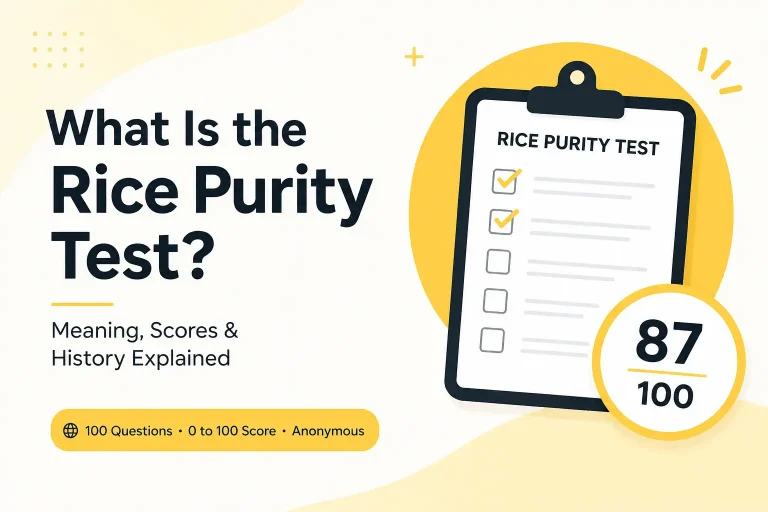
The test covers 100 questions across categories including relationships, substances, authority, and social behavior. A score of 100 indicates no exposure to the listed experiences. A score of 0 indicates exposure to all of them.
| Reason | What It Means for the User |
|---|---|
| Curiosity | Learn where personal experiences fall on a structured scale |
| Entertainment | Fast, engaging online activity with an immediate result |
| Social Comparison | Compare scores with friends in a low-stakes format |
| College Tradition | A recognized orientation and icebreaker activity |
| Self-Reflection | Track how experiences evolve across different life stages |
The test requires no registration, no payment, and no time commitment beyond a few minutes. Those 3 factors alone remove the most common barriers to participation.
The Psychology Behind the Rice Purity Test
The Rice Purity Test engages 3 core psychological drives: self-assessment, social comparison, and numerical certainty.
Self-assessment is the desire to understand oneself through structured feedback. Psychologist Leon Festinger’s 1954 Social Comparison Theory demonstrated that humans evaluate their abilities and experiences by comparing themselves to others. The Rice Purity Test provides a direct mechanism for this.
Social comparison drives people to benchmark their experiences against peers. The test converts personal history into a single number, making comparison immediate and concrete. Research published in the Journal of Personality and Social Psychology confirmed that numerical self-evaluations increase engagement because they provide a clear reference point.
Numerical certainty plays a distinct role. A score of 72 feels more informative than a vague description like “moderately experienced.” Numbers reduce ambiguity. They also make results easy to remember and easy to share.
Online quizzes that produce numerical scores consistently generate higher completion and share rates than those producing text-only results, according to behavioral research on digital engagement patterns.
Why College Students Love the Rice Purity Test
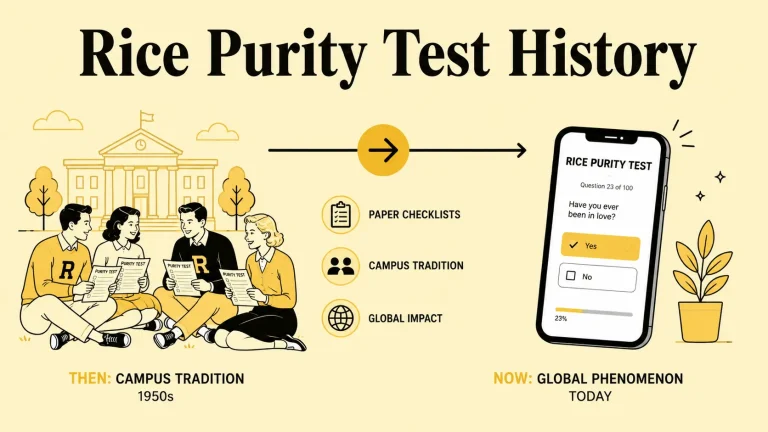
The Rice Purity Test originated at Rice University in Houston, Texas, as a tool for incoming freshmen to self-reflect before college. That origin created a durable association between the test and college culture.
College students engage with the test for 4 distinct reasons.
Orientation Bonding
Freshmen arriving at college seek immediate social connection. Sharing Rice Purity scores during orientation week creates an instant conversation topic that is personal without being invasive.
Icebreaker Function
The test covers a wide range of experiences, allowing groups to find common ground or discover differences without serious social consequences.
Peer Group Formation
Friend groups in college often form around shared experiences. The test surfaces those commonalities quickly.
Transition Marking
College represents a major life transition. The test gives students a baseline score they can reference at graduation to measure how their experiences changed. The history of the Rice Purity Test confirms that student councils and orientation programs adopted it organically — not through institutional promotion.
Want to see how your experiences compare?
Take the Rice Purity Test →Why People Compare Rice Purity Scores
People compare Rice Purity scores because comparison is the natural extension of taking the test. A score only carries meaning when placed next to another score.
Score comparison serves 3 functions.
- Conversation generation. A single number opens dialogue about specific questions without requiring either party to volunteer personal information unprompted.
- Group bonding. Shared scores — or notably different ones — create shared experiences and inside references within friend groups.
- Friendly competition. Some users treat higher or lower scores as a form of informal status, depending on the social context of their group.
Score comparisons are most valuable when treated as entertainment. The Rice Purity Test does not measure character, maturity, or social worth. People from different cultural backgrounds, geographic regions, or socioeconomic circumstances have different access to the experiences the test covers — a score of 85 from one person reflects a different set of circumstances than a score of 85 from another.
Why the Rice Purity Test Went Viral
The Rice Purity Test achieved viral distribution because it produces a single, shareable output that requires no explanation.
| Period | Main Distribution Channel |
|---|---|
| 1924–1990s | Rice University campus tradition |
| Early 2000s | Online forums and early social networks |
| 2010s | Facebook, Twitter, and group chats |
| 2020–Present | TikTok, Instagram Reels, YouTube Shorts |
TikTok accelerated the test’s reach significantly between 2020 and 2023. Users posted videos reacting to their scores, inviting followers to take the test and share results in the comments. That format created a feedback loop: reactions generated more views, more views generated more participants, and more participants generated more reactions.
Instagram Stories allowed users to post their score as a single number against a plain background — one of the most frictionless share formats available on any platform. YouTube contributed through reaction content, where creators took the test on camera and narrated their responses. Those videos generate consistent watch time because viewers are curious whether their own answers match the creator’s.
Why People Retake the Rice Purity Test
People retake the Rice Purity Test to measure how their experiences have changed over time. How the Rice Purity Test works makes this straightforward: the test takes under 5 minutes, results are immediate, and no account is required — so each session is independent.
The most common retake intervals are:
- End of freshman year vs. beginning of freshman year
- College graduation vs. college entrance
- Major relationship milestones
- Significant life transitions such as moving to a new city or changing careers
Nostalgia also motivates retaking. Adults who took the test in college often revisit it a decade later to compare their current score against what they remember scoring in their early twenties. The average Rice Purity score by age varies significantly across demographics — which itself generates curiosity about where one’s current score falls.
Why the Rice Purity Test Is Still Popular Today
The Rice Purity Test remains popular for 6 structural reasons.
- Speed. The test takes 3–5 minutes to complete from start to score.
- Anonymity. No account, email address, or personal information is required.
- No cost. The test is entirely free with no paywalled results.
- Immediate results. A score appears the moment the final question is answered.
- Shareability. One number is easier to share than a detailed personality profile.
- Cross-generational appeal. The test is not exclusive to college students. Adults in their 30s and 40s retake it for nostalgia. Younger users encounter it through social media.
Most online quizzes peak and disappear within months. The Rice Purity Test has sustained relevance for over 90 years — that combination of low friction and high social utility explains why.
Should You Compare Your Rice Purity Score With Others?
Comparing Rice Purity scores is a legitimate and common social activity, provided the comparison remains recreational.
Benefits of Comparing Scores
- Creates immediate conversation topics in social settings
- Builds group connection through shared discovery
- Makes the test more engaging than a private, solitary activity
Limitations to Keep in Mind
- Scores carry no universal context. A person raised in a rural environment has different access to certain experiences than someone raised in an urban one.
- Cultural backgrounds influence interpretation. The test was developed within a specific American college context.
- Social circles normalize different behaviors, affecting how individual questions are read.
The test measures exposure to experiences — not the quality of a person’s choices or the depth of their character. Understanding Rice Purity score meaning helps frame comparisons accurately.
Common Misconceptions About Why People Take the Test
Misconception 1: People only take the test because of peer pressure.
Peer pressure accounts for some participation, but curiosity and self-reflection are the primary drivers. Many users take the test privately, without any social prompt.
Misconception 2: Lower scores are more impressive.
Lower scores indicate exposure to more of the listed experiences. Neither a low score nor a high score carries inherent social value. Groups assign different meanings based on their own values.
Misconception 3: Higher scores are embarrassing.
A high score reflects fewer exposures to the listed experiences. For many people, that aligns precisely with their values and life choices.
Misconception 4: Everyone lies on the test.
Anonymous self-reporting reduces the social incentive to misrepresent answers. Research on anonymous survey behavior consistently shows higher honesty rates in anonymous formats compared to identified ones.
Misconception 5: The test is only for college students.
The Rice Purity Test has a documented user base spanning ages 15 to 45+. It originated in college, but social media distributed it to a much broader demographic. What is the Rice Purity Test? covers its full audience range in detail.
Frequently Asked Questions
Why do people take the Rice Purity Test?
People take the Rice Purity Test to satisfy curiosity about their own experiences, compare scores with friends, participate in a recognized college tradition, and engage with a shareable online activity that produces an immediate numerical result.
Why is the Rice Purity Test so popular?
The Rice Purity Test is popular because it is free, anonymous, fast to complete, and produces a single shareable number. Those 4 characteristics make it low-barrier and socially versatile across platforms including TikTok, Instagram, and group chats.
Why do people compare Rice Purity scores?
People compare Rice Purity scores because the test’s numerical format makes comparison direct and immediate. Score sharing serves as a conversation starter, a group bonding activity, and a form of friendly competition.
Why do people retake the Rice Purity Test?
People retake the Rice Purity Test to track how their experiences have changed over time, particularly at life milestones such as college graduation, relationship changes, or major relocations. Nostalgia also motivates adults to revisit their college-era scores.
Is the Rice Purity Test only for college students?
The Rice Purity Test originated at Rice University as a college tradition, but it is not limited to college students. Social media has distributed the test to users across age groups, with participation from teenagers through adults in their 40s.
Why did the Rice Purity Test go viral?
The Rice Purity Test went viral because it produces a single number that is easy to post, react to, and discuss across social platforms. TikTok accelerated its spread through reaction video formats that invited mass participation between 2020 and 2023.
Ready to discover your own score?
Take the Rice Purity Test Today →