What Is a Good Rice Purity Score? (Is Your Score Normal?)
There is no official “good” or “bad” Rice Purity Score. Here’s how to actually read your number, without the guesswork or the guilt.
Is There Such Thing as a Good Rice Purity Score?
There is no official “good” Rice Purity score. Every score reflects a different set of life experiences, not a grade to pass or fail.
The Rice Purity Test assigns a number between 0 and 100 based on 100 yes-or-no statements about personal experiences. A higher number means fewer of those statements apply. A lower number means more of them do. Neither direction is correct or incorrect.
The test was built for entertainment and self-reflection, not evaluation. College students originally used it as an icebreaker, and that purpose has stayed the same for decades. A score is a snapshot, not a scoreboard.
Scores should never be treated as a measure of personal worth. Two people with identical scores can have completely different backgrounds, values, and stories behind their numbers.
What Makes a Rice Purity Score “Good”?
A Rice Purity score becomes “good” only in relation to the person holding it, not to a fixed benchmark. Several factors shape how a score should be read.
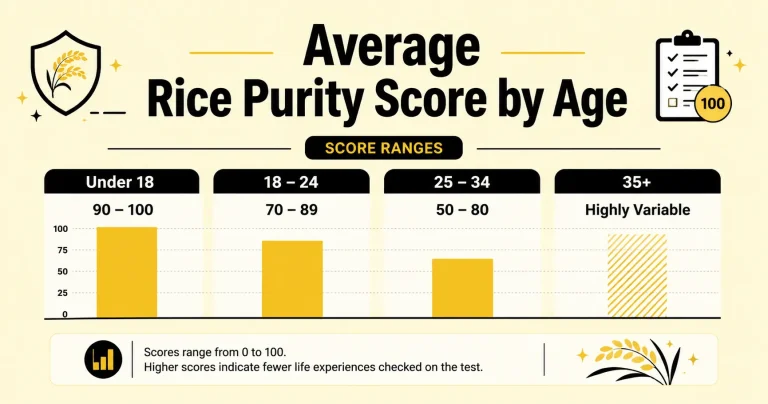
Age plays the largest role. A 16-year-old and a 26-year-old answering the same 100 statements will land in different ranges, simply because they have had different amounts of time to accumulate experiences.
Lifestyle also matters. Someone who lives at home, attends a small college, or works a quiet job will likely score differently than someone who moved abroad, joined a large university, or works in nightlife.
Personal values, culture, and religion shape which experiences a person seeks out or avoids entirely. A devout individual and a secular individual may both feel confident with very different scores.
Social environment rounds out the picture. Friend groups, campus culture, and family upbringing all influence which statements on the test apply to a given person.
Because these factors vary so widely, “good” cannot mean the same number for everyone. A good score is simply one that reflects a person’s actual life accurately, not one that matches a specific target.
Understanding Rice Purity Score Ranges
Rice Purity scores fall into four general bands. This section offers a brief summary only. For a full breakdown of what each range means, read the Rice Purity Score Meaning guide.
| Score Range | General Interpretation |
|---|---|
| 90–100 | Very Innocent |
| 70–89 | Typical |
| 50–69 | More Experienced |
| 0–49 | Broad Life Experience |
These bands describe patterns, not judgments. A score in any range can belong to a well-adjusted, thoughtful person with a full and satisfying life.
Is 95 a Good Rice Purity Score?
Yes, 95 is a good Rice Purity score, and it is common among younger test-takers. Scores in the 90s typically belong to teenagers, first-year students, or anyone who has had fewer opportunities for certain experiences so far.
A score of 95 does not mean someone will stay inexperienced forever. Life stages change, circumstances change, and a score taken at 16 will almost never match a score taken at 26. Avoid treating a high score as a permanent label or a low score as more mature; both stereotypes misread what the test actually measures.
Is 80 a Good Rice Purity Score?
Yes, 80 is a good Rice Purity score, and it sits among the most common ranges reported by students and young adults. A score of 80 usually reflects a handful of milestone experiences alongside plenty of untouched statements on the list.
This range represents normal variation rather than a midpoint to aim for. Two friends who both score 80 can still have taken very different paths to get there, since the test does not weigh which specific statements were checked.
Is 60 a Good Rice Purity Score?
Yes, 60 is a good Rice Purity score, and it often reflects broader life experience gained through college, relationships, or independent living. Many adults land in this range once they move beyond adolescence and into more autonomous stages of life.
A score of 60 is not something to judge positively or negatively. It simply indicates more checked statements than the average teenager, which is expected as life circumstances expand with age.
Is 40 or Lower a Bad Rice Purity Score?
No, a score of 40 or lower is not a bad Rice Purity score. Scores in this range reflect accumulated experiences, not character flaws or poor decision-making.
Context always matters more than the number itself. People follow different life paths at different speeds, and a lower score can belong to someone in their thirties just as easily as someone in their early twenties. The test has no penalty system and no correct answer key.
Wondering how your score compares?
Take the Rice Purity TestShould You Compare Your Rice Purity Score With Friends?
Comparing Rice Purity scores with friends can be enjoyable, but it has real limitations worth understanding.
Benefits of comparing scores:
- Sparks fun conversation among friends
- Works as a natural icebreaker in group settings
- Encourages shared curiosity about each other’s experiences
Limitations of comparing scores:
- Friends often come from different family backgrounds
- Cultural expectations vary from person to person
- Access to certain opportunities is not equal for everyone
- Personal values shape which experiences someone chooses to pursue
A friend group comparing scores should treat the exercise as lighthearted rather than competitive. The moment a score becomes a source of pressure or embarrassment, it has stopped serving its original purpose.
Factors That Influence Whether a Score Seems High or Low
Several external factors shape how high or low a given score turns out to be, independent of personal character.
| Factor | Influence |
|---|---|
| Age | High |
| College Life | High |
| Relationships | High |
| Lifestyle | High |
| Culture | High |
| Religion | Medium |
| Family Upbringing | Medium |
| Friend Groups | Medium |
Age determines how much time a person has had to accumulate experiences. College life introduces new social settings, independence, and opportunities that were previously unavailable. Relationships add or remove entire categories of statements from someone’s list.
Culture and religion guide which experiences a person actively pursues or deliberately avoids. Family upbringing shapes early attitudes toward independence, dating, and social behavior. Friend groups influence exposure to new environments, from parties to travel to different social norms.
Understanding these factors explains why comparing raw scores across different people rarely produces a fair comparison. To see how scores typically shift across different age groups, review Average Rice Purity Score by Age.
What Your Rice Purity Score Does NOT Say About You
A Rice Purity score does not measure personality, intelligence, morality, success, kindness, mental health, or emotional maturity.
The test consists of 100 yes-or-no statements about specific experiences. It cannot capture how thoughtful someone is, how they treat others, or how they handle challenges. Two people with the same score can differ completely in character, ambition, and emotional depth.
Treating the score as a personality summary misunderstands its original design. The test was never built to assess who someone is, only which of 100 specific statements happen to apply to them at one point in time.
Common Myths About Good Rice Purity Scores
Why Scores Naturally Change Over Time
A Rice Purity score is not fixed. Life stages shift, circumstances change, and the same person retaking the test five years later will almost certainly land on a different number.
This natural drift explains why comparing an 18-year-old’s score against a 25-year-old’s score produces little useful information. It also explains why people sometimes feel attached to an old score, even after their life circumstances have moved on. Understanding how the Rice Purity Test works makes this shift easier to expect rather than fear.
Frequently Asked Questions
What is a good Rice Purity score?
A good Rice Purity score is any score that accurately reflects a person’s own experiences. No single number qualifies as objectively good or bad.
Is 95 a good Rice Purity score?
Yes. A score of 95 is common among teenagers and younger test-takers and reflects fewer accumulated experiences so far, not a permanent trait.
Is 90 a good Rice Purity score?
Yes. A score of 90 falls within the “Very Innocent” range and is typical for younger users or those with more conservative lifestyles.
Is 80 a good Rice Purity score?
Yes. A score of 80 is one of the most commonly reported scores among students and young adults and represents normal variation.
Is 60 a good Rice Purity score?
Yes. A score of 60 often reflects broader life experience gained through college, relationships, or independent living, and is common among adults.
Is 40 a bad Rice Purity score?
No. A score of 40 reflects accumulated life experiences rather than poor character, and context always matters more than the number itself.
Is there a perfect Rice Purity score?
No. The test was designed to capture variation across different people, not to reward one specific number over another.
Should I compare my Rice Purity score with others?
Comparing scores with friends can be fun, but differing backgrounds, cultures, and personal values make direct comparisons unreliable as a measure of anything meaningful.
Ready to discover your score?
Take the Rice Purity Test NowFor more background on the test itself, explore What Is the Rice Purity Test?, History of the Rice Purity Test, and the full Rice Purity Test blog for more guides like this one.