Rice Purity Test vs Innocence Test: What’s the Difference?
The Rice Purity Test and the Innocence Test both use a checklist to measure life experiences, but they are not the same quiz. The Rice Purity Test is a standardized 100-question survey created at Rice University, scored from 0 to 100. The Innocence Test is a general category of online quizzes with no single official version, no fixed question count, and no shared scoring system.
Both quizzes serve entertainment and self-reflection purposes. Neither measures personality, morality, or character. This guide compares their origins, structure, scoring, and popularity, then helps you decide which one fits what you’re looking for.
Rice Purity Test vs Innocence Test: Quick Comparison
Both tests ask users to check off life experiences from a list, then generate a score based on the number of items marked. Both rely on self-reported, unverified answers, and both are meant to be shared with friends rather than used for clinical evaluation.
The main difference comes down to origin and consistency. The Rice Purity Test traces back to a specific university tradition and has kept the same 100-question format for decades. Innocence Tests come from many independent creators, so the questions, scoring, and length vary from site to site.
| Feature | Rice Purity Test | Innocence Test |
|---|---|---|
| Origin | Rice University tradition | Various online creators |
| Questions | Usually 100 | Varies |
| Score | 0–100 | Varies |
| Popularity | Very High | Moderate |
| Purpose | Entertainment & self-reflection | Entertainment |
What Is the Rice Purity Test?
The Rice Purity Test is a 100-question checklist that scores life experience on a scale of 0 to 100. A lower score reflects more reported experiences, while a higher score reflects fewer. The test originated at Rice University in Houston as an orientation activity for incoming students.
Students used the checklist to compare backgrounds and break the ice before classes began. The format spread to other universities over several decades, then moved online, where it reached a far larger audience beyond college campuses. How the Rice Purity Test works explains the scoring mechanics in full detail.
What Is an Innocence Test?
An Innocence Test is any online quiz that scores a person’s life experience or perceived innocence using a checklist format. Unlike the Rice Purity Test, no single original version exists. Independent websites, quiz platforms, and social media creators each built their own take on the concept.
This means question count, topics covered, and scoring scales differ between versions. Some Innocence Tests use 50 questions, others use 30 or 150. Some score from 0 to 100, others use percentages or descriptive labels instead of numbers.
The absence of a standard version is the main reason Innocence Tests are difficult to compare directly against a Rice Purity Score. Each Innocence Test reflects its creator’s individual choices rather than a shared, established format.
Key Differences Between the Two Tests
Seven factors separate the Rice Purity Test from a typical Innocence Test: history, question style, scoring, popularity, structure, purpose, and audience.
History
The Rice Purity Test began as a documented university tradition. Innocence Tests emerged later as a general online quiz category, without one founding institution behind them.
Question Style
Rice Purity Test questions cover a broad range of experiences, including academic milestones, social activities, and lifestyle choices, in a consistent 100-item list. Innocence Test questions vary by site, and some focus on narrower themes.
Scoring
The Rice Purity Test uses a fixed 0–100 scale that has stayed consistent since its creation. Innocence Tests use inconsistent scoring systems, which makes score comparisons between different Innocence Test websites unreliable.
Popularity, Structure, Purpose, and Audience
The Rice Purity Test benefits from decades of use and viral spread across platforms like TikTok and Instagram. Innocence Tests have smaller, fragmented audiences spread across competing versions. Both share the same entertainment purpose, but the Rice Purity Test’s college roots continue to attract students and young adults who want to compare scores with peers, while Innocence Tests attract a broader, more general quiz audience.
| Category | Rice Purity Test | Innocence Test |
|---|---|---|
| History | Originated at Rice University | Originated from multiple independent creators |
| Question Style | Fixed 100-question checklist | Varies by website |
| Scoring | Standardized 0–100 scale | Inconsistent across versions |
| Popularity | Widely recognized, viral on social media | Moderate, fragmented across sites |
| Structure | Consistent format since creation | No fixed structure |
| Purpose | Entertainment and self-reflection | Entertainment |
| Audience | College students and young adults | General quiz-takers |
Ready to see your own score? Take the official Rice Purity Test and compare your results.
Take the Rice Purity TestWhich Test Is More Accurate?
Neither test is scientifically validated. Both rely on self-reported answers, which means results depend entirely on how honestly a person completes the checklist.
The Rice Purity Test and Innocence Test share the same limitation: they measure reported experiences, not personality, morality, or character. A Rice Purity Score reflects a snapshot of activities a person has or has not done, not a judgment of who they are.
Accuracy in either test comes down to honest self-assessment rather than quiz design. Innocence Test scores vary so widely between versions that comparing one to a Rice Purity Score produces no meaningful result.
Which Test Is More Popular?
The Rice Purity Test has a documented history that predates most online purity quizzes. Its university origin gave it a built-in audience of students who carried the tradition to other campuses over time.
Social media accelerated this growth. Students began sharing Rice Purity Test scores on Instagram and TikTok, introducing the quiz to audiences far beyond college campuses. This viral spread established the Rice Purity Test as the most recognized quiz in its category.
Innocence Tests exist in many versions largely because the concept is open-ended. Without one official format, different creators built independent variations to capture search traffic and quiz-platform engagement. This has kept Innocence Tests in circulation, but has also prevented any single version from reaching the same recognition as the Rice Purity Test.
Confusion between the two terms is common. Many people searching for “innocence test” are actually looking for the Rice Purity Test, since both terms describe similar checklist-style quizzes. This overlap in search behavior explains why comparison articles on this topic frequently blur the line between them.
Which Test Should You Take?
The right test depends on what you want out of the experience.
- Choose the Rice Purity Test for a long-standing college tradition
- Choose the Rice Purity Test to compare scores directly with friends
- Choose an Innocence Test for a different quiz style or added variety
- Choose either test for casual, low-stakes entertainment
| You Want To… | Recommended Test |
|---|---|
| Compare scores with friends | Rice Purity Test |
| Follow a college tradition | Rice Purity Test |
| Try a casual online quiz | Innocence Test |
| Explore multiple quiz formats | Both |
Pros and Cons
Advantages of the Rice Purity Test
- Standardized 100-question format enables direct score comparisons
- Decades-long history adds credibility and recognition
- Widely shared on social media, making peer comparison easy
- Consistent 0–100 scoring scale across all official versions
Advantages of the Innocence Test
- Multiple versions offer variety in question style
- Shorter formats available for quick completion
- Accessible across many different quiz platforms
Limitations of Both Tests
- Neither test is scientifically validated
- Both rely on self-reported, unverified answers
- Neither measures personality, morality, or character
- Scores cannot be used for clinical or diagnostic purposes
Can You Take Both Tests?
Yes. Taking both the Rice Purity Test and an Innocence Test offers two different experiences, since the question sets and scoring systems differ. Many people take both out of curiosity, then compare the results side by side.
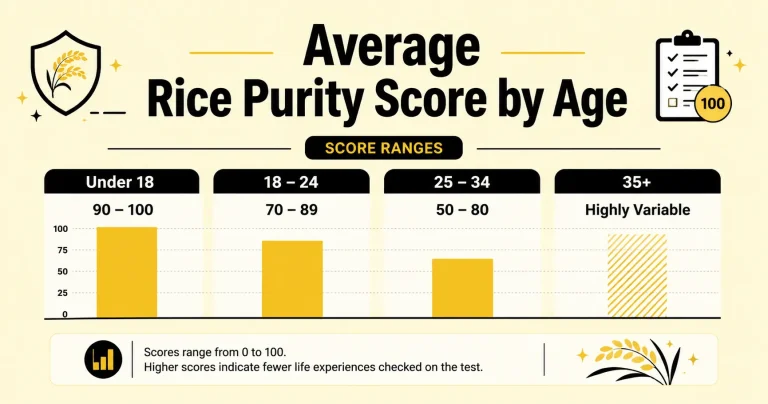
There is no right or wrong choice between the two. Some users prefer the Rice Purity Test’s consistency, while others enjoy trying different Innocence Test versions to see how the questions vary. The average Rice Purity Score by age offers additional context for anyone comparing results across different age groups.
Now that you understand the differences, take the Rice Purity Test and discover where your score falls.
Take the Official TestFrequently Asked Questions
No. The Rice Purity Test is a specific 100-question quiz from Rice University, while an Innocence Test refers to any of several unrelated online quizzes with no single standard format.
Neither test is objectively better. The Rice Purity Test offers a standardized format ideal for comparing scores, while Innocence Tests offer variety across different quiz styles.
Neither test is scientifically validated. Accuracy in both depends on how honestly a person answers the checklist.
No single official Innocence Test exists. Multiple independent creators have published their own versions, each with different questions and scoring systems.
The Rice Purity Test’s university origin, decades-long history, and viral spread on social media have made it the most recognized quiz of its kind.
Yes. Taking both quizzes provides two different experiences and allows for a fun comparison of results.
The Rice Purity Test consistently uses 100 questions. Innocence Test question counts vary by version, ranging from as few as 20 to more than 100.