Rice Purity Score Meaning (0–100 Explained)
What your score actually tells you — and what it doesn’t
What Is a Rice Purity Score?
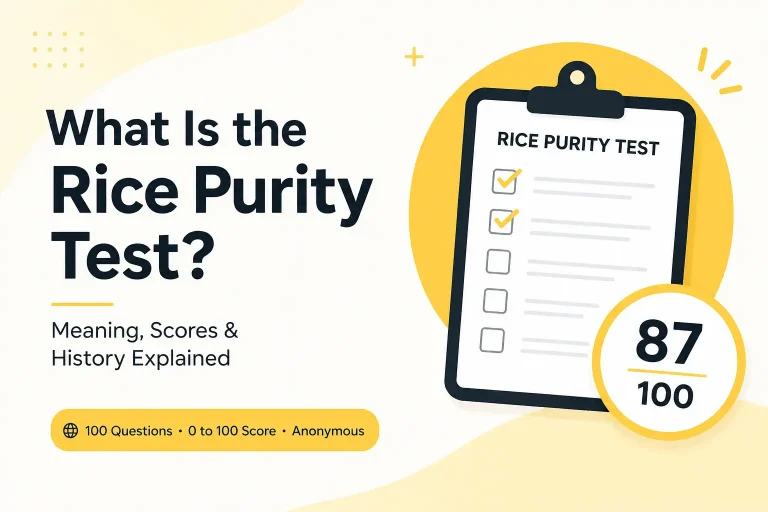
A Rice Purity Score is a self-reported numerical value assigned after completing the Rice Purity Test — a 100-question survey originally developed at Rice University in Houston, Texas. Each question asks whether the respondent has engaged in a specific experience, ranging from holding hands to more advanced social and personal behaviors.
The test has 4 key characteristics that define what it measures:
- Self-reported — answers are not verified by any external authority
- Cumulative — each “yes” answer reduces the score by one point
- 100-question scope — covering social, romantic, sexual, and personal experiences
- Single output — a number between 0 and 100
The score represents breadth of experience, not depth. A person who has had one intense experience scores identically to someone with 20 mild ones, as long as both check the same number of items.
How Rice Purity Scores Work
The scoring formula is straightforward. The Rice Purity Test contains 100 questions. Each question answered “yes” subtracts one point from a starting score of 100.
Example: A person who answers “yes” to 23 questions receives a score of 77.
Example: A person who answers “yes” to 60 questions receives a score of 40.
All questions carry equal weight. The test does not distinguish between minor and major experiences — each item counts as exactly one point. This equal weighting is the test’s primary limitation as a behavioral or psychological tool, which is why scores function as a social benchmark rather than a scientific measure.
Scores range from 0 to 100. A score of 100 means no boxes were checked. A score of 0 means all 100 questions were answered affirmatively — an extremely rare outcome.
Rice Purity Score Breakdown
The 4 primary score ranges each carry a distinct interpretation based on accumulated life experience. Different ranges reflect different levels of exposure to the social, romantic, and personal experiences the test covers.
| Score Range | Interpretation | Most Common In |
|---|---|---|
| 90–100 | Very Innocent | Under 18 / early teens |
| 70–89 | Average | High school & early college |
| 50–69 | Experienced | College years & mid-20s |
| 0–49 | Very Experienced | Late 20s & beyond |
90–100 Score Meaning
A score between 90 and 100 reflects very limited exposure to the experiences covered by the test. Users in this range have checked fewer than 10 boxes across all 100 questions.
This range is most common among teenagers and younger users who have not yet encountered many social, romantic, or independent-living experiences. A 14-year-old who has never dated, attended parties, or lived away from home naturally scores here.
A high score is not better or worse than a low one. It reflects a stage of life and a specific set of circumstances — geography, family structure, school environment, and personal choices all influence where someone lands. Many users who score between 90 and 100 retake the test years later and observe significant decreases, which reflects the natural accumulation of experience over time.
70–89 Score Meaning
A score between 70 and 89 is the most common range among adult users, particularly those in high school, early college, or their early twenties. Self-reported surveys from Rice Purity Test communities consistently show this range as the statistical mode.
Users in this range have typically experienced romantic relationships, social gatherings, and some degree of independent decision-making. They have not, however, engaged with a wide range of the more advanced experiences the test covers.
College students frequently land here after their first year away from home, as new social environments introduce experiences they had not previously encountered. The 70–89 range represents the average college-age adult in the United States.
50–69 Score Meaning
A score between 50 and 69 indicates increased social exposure and a broader range of personal experiences. Users in this range have engaged with a meaningful portion of the relationship, social, and lifestyle experiences the test covers.
This range is common among college students in their second and third years, young adults in their mid-to-late twenties, and individuals who have lived independently for several years. Greater independence, wider social circles, and longer relationship histories all contribute to scores here.
A score in the 50–69 bracket does not indicate recklessness, poor judgment, or any negative quality. It reflects accumulated experience across the life domains the test covers.
0–49 Score Meaning
A score between 0 and 49 reflects the broadest range of life experiences measured by the test. Users in this range have answered “yes” to more than half of the 100 questions, indicating engagement with a wide variety of social, romantic, sexual, and personal experiences.
Scores below 50 are more common among adults in their late twenties and beyond, individuals with extensive social or relationship histories, and those who have navigated wide-ranging life circumstances.
A low score carries no moral judgment. The test does not evaluate whether choices were healthy, consensual, ethical, or wise — it only records whether specific experiences occurred. Two people with identical scores of 30 may have arrived at that number through completely different life paths.
Not sure where your score falls?
Take the free test and compare your results to the ranges above.
What Is a Good Rice Purity Score?
There is no objectively good or bad Rice Purity score. The test has 4 structural reasons why treating any score as “better” is misleading:
- Age influences scores directly — a 16-year-old and a 26-year-old are not comparable on the same scale
- Environment shapes experience — someone raised in a rural community has different exposure to certain experiences than someone raised in a large city
- Equal weighting distorts judgment — a score of 70 can reflect very different life paths for different people
- No psychological validation — the test was designed as a social activity, not a clinical instrument
Comparing scores between friends can be enjoyable as a social activity. Treating those comparisons as meaningful assessments of character, maturity, or lifestyle quality is not supported by the test’s design.
What Your Rice Purity Score Says About You
A Rice Purity Score reflects how many of the 100 listed experiences a person has had — and nothing beyond that. The score does not reveal personality type, emotional intelligence, relationship quality, future behavior, or life satisfaction.
What scores may suggest, within narrow limits:
- Higher scores (80–100) suggest fewer checked life experiences, often correlating with younger age or more sheltered environments
- Moderate scores (50–79) suggest a mix of social, romantic, and personal experiences typical of young adulthood
- Lower scores (0–49) suggest broader engagement with the full range of experiences the test covers
What scores do not reveal:
- Whether a person is happy or unhappy
- Whether choices were made thoughtfully or impulsively
- Whether a person is ready for relationships, work, or adult responsibilities
- Any measure of mental or emotional health
Average Rice Purity Score
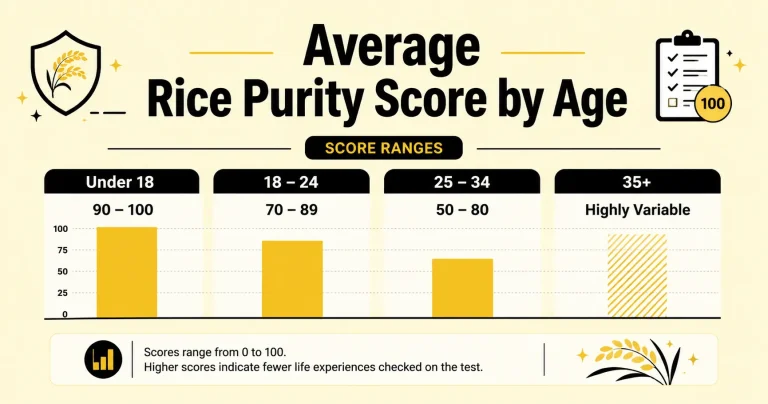
The average Rice Purity Score falls between 70 and 80 for adult users in the United States, based on aggregated self-reported data from online communities and surveys conducted across college populations. This average shifts meaningfully by age group.
| Age Group | Typical Score Range | Key Factor |
|---|---|---|
| Under 18 | 85–100 | Limited independent social exposure |
| 18–24 | 65–85 | College environment accelerates change |
| 25+ | 45–75 | Widest variation; divergent life paths |
Younger users score higher because they have had fewer years to accumulate the experiences the test covers. College-age users (18–24) typically see the most dramatic score changes in a short period, as leaving home, entering new social environments, and forming adult relationships all affect scores simultaneously. Adults over 25 show the widest variation, reflecting increasingly divergent life paths after the early twenties.
Why Rice Purity Scores Change Over Time
Rice Purity scores decrease over time because life experiences accumulate and scores can only move in one direction — downward. Once a person has had an experience, it remains part of their history.
The 3 life stages where score changes are most pronounced:
- High school (14–18) — First romantic relationships, first social gatherings, and early independence contribute to initial score decreases
- College (18–22) — Living away from home produces the fastest and most significant score changes for most users
- Young adulthood (22–30) — Longer relationship histories, broader social circles, and independent living continue the downward trend
Many users retake the test multiple times over the years to observe their score progression. This is one of the primary reasons the test maintains cultural popularity — it functions as a personal milestone tracker that reflects the passage of time through experience. To understand the full background, see What Is the Rice Purity Test?
Common Myths About Rice Purity Scores
The Rice Purity Test has 6 common misconceptions that users regularly encounter and repeat:
The test records experiences — not ethical judgments. A score of 20 reflects a broad range of activities, not a character flaw.
A high score reflects fewer experiences on the test’s specific list. It says nothing about creativity, personality, depth of relationships, or life satisfaction.
The Rice Purity Test does not assign moral weight to any item. Every question is neutral in framing — it asks “did this happen,” not “was this right or wrong.”
Personality traits like openness, conscientiousness, and emotional stability are not correlated with Rice Purity scores. The test has no predictive validity for personality.
Maturity involves emotional regulation, responsibility, and self-awareness — none of which the Rice Purity Test evaluates.
The test has not been validated by any psychological research body. It is a social activity, not a diagnostic instrument.
Why People Compare Rice Purity Scores
Rice Purity score comparisons serve 5 distinct social functions that explain why the test remains culturally relevant:
- Curiosity — People are naturally curious about where they fall relative to peers, particularly during transitional life stages
- Group bonding — Taking the test together and sharing scores creates shared experiences and conversation without direct personal disclosure
- College culture — The test originated at a university and remains embedded in college social traditions across the United States
- Social comparison — Scores allow people to contextualize their own experiences without making explicit personal statements
- Online sharing — Social media and forums like Reddit make score sharing a common icebreaker, particularly among users aged 16–24
The emotional attachment many users feel toward their scores reflects the test’s function as a form of personal identity expression. Users do not just share numbers — they share a snapshot of their life history at a specific moment in time.
Is the Rice Purity Test Scientifically Accurate?
The Rice Purity Test is not a scientifically validated instrument. It has 4 structural limitations that prevent it from functioning as a psychological or behavioral assessment:
- Equal weighting — All 100 questions count equally, regardless of the significance of the experience
- No normative data — There is no standardized reference population against which scores are calibrated
- Self-report bias — Answers are not verified and may be influenced by social desirability
- No psychometric validation — The test has not been peer-reviewed or validated for reliability and validity
These limitations do not reduce the test’s value as a social activity or cultural phenomenon. The test functions as a fun social benchmark — a structured way to reflect on personal history and compare experiences with others. Treating it as a psychological assessment, a measure of character, or a predictor of future behavior is not supported by its design or origins.
For more context, see What Is the Rice Purity Test?
Ready to see where you fall on the scale?
Take the free Rice Purity Test and compare your score to the average.
Frequently Asked Questions
What is a good Rice Purity score?
There is no universally good Rice Purity score. The score reflects life experience, which varies by age, environment, and personal history. A 17-year-old and a 27-year-old have lived different lives — their scores are not meaningfully comparable. Any score between 0 and 100 is a valid reflection of the person who earned it.
Is 95 a good Rice Purity score?
A score of 95 indicates that the person has checked 5 or fewer boxes out of 100. This is common among younger users and those with limited exposure to the social, romantic, and personal experiences the test covers. It is neither good nor bad — it reflects a specific life stage.
Is 50 a bad Rice Purity score?
A score of 50 is not bad. It indicates engagement with half of the 100 experiences on the test. This is within the normal range for adults in their mid-to-late twenties and carries no moral or character implication.
What is the average Rice Purity score?
The average Rice Purity score falls between 70 and 80 for adult users. College-age users (18–24) typically score between 65 and 85, while users under 18 tend to score between 85 and 100. Adults over 25 show the widest variation, with scores ranging broadly across the 0–100 spectrum.
Why is my Rice Purity score low?
A low Rice Purity score reflects a broad range of life experiences covered by the test’s 100 questions. Low scores are more common among older users, those who have lived independently for longer periods, and those with extensive social or relationship histories. A low score does not indicate poor judgment or negative character traits.
Can my Rice Purity score change over time?
A Rice Purity score decreases over time as experiences accumulate. Scores cannot increase — once an experience has occurred, that question remains checked. Most users see their largest score decreases during college or in the years immediately following high school, when new environments introduce a broader range of experiences.