History of the Rice Purity Test
(From Rice University to Today)
The Rice Purity Test has a documented history spanning several decades. It originated as a student-administered survey at Rice University in Houston, Texas, and has since evolved into one of the internet’s most widely shared self-assessment quizzes.
What Is the History of the Rice Purity Test?
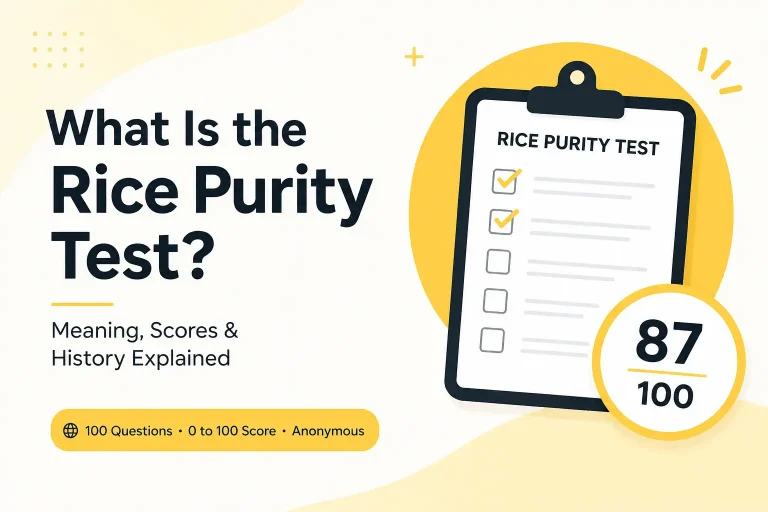
The Rice Purity Test is a 100-question self-graded survey that measures a person’s exposure to a range of life experiences — from romantic and social activities to substance use and personal conduct. Its history begins as a university tradition and extends into a global digital phenomenon.
The test did not emerge from a single defining moment. It developed gradually through student culture at Rice University and was refined over decades before the internet carried it to a worldwide audience.
The Origin of the Rice Purity Test
The Rice Purity Test originates from Rice University, a private research university located in Houston, Texas. Student organizations at Rice University used early versions of the test during freshman orientation periods beginning in the mid-20th century.
The original purpose was structured social interaction. Incoming students completed the survey as a group activity, comparing results to build early friendships during the transition to college life.
Rice University did not officially author or endorse the test. Student groups created and distributed it independently, which contributed to its informal, evolving character.
The name “Rice Purity Test” reflects its geographic origin. The “purity” element refers to the score itself — a higher number indicates fewer experiences checked on the list, representing a measure of personal innocence relative to the surveyed behaviors.
Why Was the Rice Purity Test Created?
The Rice Purity Test was created to serve 3 primary social functions among incoming college students.
Icebreaker activity. The test gave freshmen a structured conversation starter. Discussing scores created immediate common ground between students who had no prior relationship.
Self-reflection tool. Students used the survey to assess their own experiences compared to peers. The scoring system provided a simple, quantifiable reference point.
Friendship formation. Group participation in the test accelerated social bonding. Shared vulnerability around personal topics created a sense of mutual trust during a period of social adjustment.
These functions explain why the test spread organically through universities beyond Rice. The core social utility required no institutional endorsement to replicate.
The Original Rice Purity Test
The earliest versions of the Rice Purity Test circulated as paper checklists. Students received printed sheets, marked their responses privately, and calculated their own scores by counting unchecked items.
The original format was not standardized. Different student groups produced their own versions, varying in question count, topic coverage, and scoring methodology. Some versions contained fewer than 100 questions. Others included questions specific to campus culture at Rice University.
Manual scoring was the only method available. A student counted the number of items they had not experienced to produce their purity score.
The paper format limited distribution to physical proximity. The test remained a localized tradition for decades, passing from one class of students to the next through informal channels.
How the Rice Purity Test Changed Over Time
The Rice Purity Test underwent 4 significant phases of development that transformed it from a campus handout into a global quiz.
Standardization to 100 questions. Over time, 100 questions became the recognized standard. This structure simplified scoring — a student’s score represented the number of unchecked items out of 100, making results immediately comparable.
Internet adoption in the 1990s. As universities connected to the early internet, students began sharing the test through email lists, Usenet groups, and basic web pages. The test reached students at universities with no prior connection to Rice University.
Online quiz platforms in the 2000s. Dedicated websites began hosting interactive versions of the test. Automated scoring replaced manual counting. Users received instant results, which reduced friction and increased participation.
Social media acceleration in the 2020s. Platforms including TikTok, Instagram, and Reddit introduced the Rice Purity Test to audiences outside the traditional college demographic. Users shared their scores as content, generating viral engagement cycles.
Rice Purity Test Timeline
| Period | Development |
|---|---|
| Mid-20th Century | Student groups at Rice University create early paper versions for freshman orientation |
| 1970s–1980s | Test becomes an established annual tradition; student-produced versions vary in format |
| Early 1990s | Internet distribution begins through university email networks and early web pages |
| Late 1990s–2000s | Dedicated websites host interactive versions with automated scoring |
| 2010s | Mobile compatibility expands access; quiz apps increase casual participation |
| 2020–Present | TikTok, Instagram, and Reddit drive viral adoption; global audience reaches millions of users |
Curious how your experiences compare? Take the test and receive your score in minutes.
Take the Rice Purity Test →Why the Rice Purity Test Became Viral
The Rice Purity Test achieved viral status through 5 reinforcing mechanisms that social media platforms amplified.
Shareable numeric score. A single number between 0 and 100 is immediately communicable. Users post their score in a caption, a comment, or a video without requiring additional explanation.
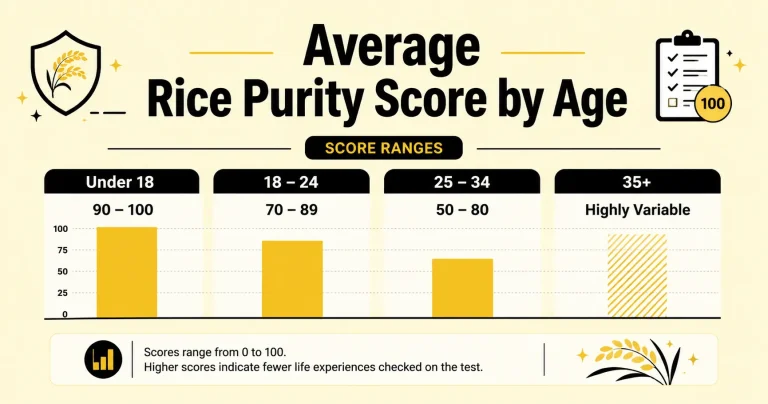
Social comparison. The scored format invites comparison. Audiences respond to questions about what constitutes a typical score, which drives discussion and repeat engagement. For reference data on score distribution, see Average Rice Purity Score by Age.
TikTok discovery cycles. Short-form video creators shared their scores and reactions in 2020 and 2021. Viewer curiosity produced search traffic, which returned new participants to online quiz sites.
Group participation format. The test functions well as a group activity. Friends complete it together during social gatherings, college orientations, and video calls — replicating the original function it served at Rice University.
Universal accessibility. The test requires no account, no payment, and no prior knowledge. Any user with internet access can complete it in under five minutes.
How the Internet Changed the Rice Purity Test
The internet transformed the Rice Purity Test across 4 measurable dimensions.
Instant scoring. Online versions eliminated manual counting. Users receive their result immediately upon completion, which removes a barrier that limited casual participation.
Anonymous participation. Web-based versions do not require users to disclose their identity. Anonymity encourages honest responses and removes social risk from participation.
Global reach. The test is no longer associated exclusively with Rice University or American college students. Users across Europe, Asia, South America, and Australia participate through English-language quiz sites.
Multiple versions. The internet produced dozens of variations hosted on independent websites. Some versions modify specific questions for contemporary relevance. Others add categories not present in the original format. To understand the What Is the Rice Purity Test standard structure, that guide covers the current format in full detail.
Is Today’s Rice Purity Test the Original Version?
Today’s Rice Purity Test is not identical to the original university version. The current standardized 100-question format represents a refined iteration of the original student surveys.
The original test varied by student group and academic year. No single canonical version existed in the paper-distribution era. Online versions standardized the question set. The most widely recognized version contains 100 questions organized by category, including experiences related to romance, substance use, academic conduct, and social behavior.
Multiple websites now host versions that differ in question phrasing, ordering, and category structure. None of these websites is affiliated with Rice University. The core concept has remained consistent across all versions — the test measures self-reported life experience using a scored checklist, and higher scores continue to represent fewer checked experiences.
| Original Format | Current Format |
|---|---|
| Paper checklist distributed by hand | Online quiz accessible on any device |
| Manual scoring by counting responses | Automated instant scoring |
| Campus-only distribution at Rice University | Worldwide access with no geographic restriction |
| Student group activity during orientation | Individual participation available at any time |
| Variable question count and phrasing | Standardized 100-question format |
| Results shared verbally among peers | Results shared publicly via social media |
Why the Rice Purity Test Is Still Popular
The Rice Purity Test maintains consistent engagement across new generations of users for 4 documented reasons.
Curiosity about personal standing. Users want to quantify their life experiences relative to peers. The scored format satisfies this curiosity with a concrete number. For a breakdown of what different scores indicate, see Rice Purity Score Meaning.
College culture continuity. Universities continue to use the test as an informal orientation activity. Each incoming class encounters the test through peers, sustaining the tradition that began at Rice University.
Repeat participation. Users retake the test as they age to observe how their score changes over time. This behavior generates return traffic and extended engagement.
Social media content cycles. Each major platform expansion — from Facebook to Instagram to TikTok — introduces the test to a new cohort of users who share results with their networks, restarting the discovery cycle.
Why University Traditions Helped the Test Survive
University traditions possess a structural advantage over other cultural artifacts: they have built-in renewal mechanisms.
Each academic year delivers a new cohort of freshmen who have not yet encountered the tradition. Returning students introduce the Rice Purity Test to newcomers during orientation weeks. This annual reset prevented the test from fading during the decades before the internet could distribute it globally.
The tradition also benefited from its informal ownership structure. Because no institution held exclusive rights to the test, no institution could discontinue it. Student groups adapted it freely, ensuring continuity despite changing campus contexts.
This survival mechanism contrasts with officially produced content, which depends on organizational decisions about continuation and distribution.
Frequently Asked Questions
Who created the Rice Purity Test?
The Rice Purity Test was created by student groups at Rice University in Houston, Texas. No single individual is credited as the definitive author. The test developed through collective student use over multiple academic generations.
Where did the Rice Purity Test originate?
The Rice Purity Test originated at Rice University in Houston, Texas. Student organizations distributed early versions during freshman orientation activities beginning in the mid-20th century.
Was the Rice Purity Test created by Rice University?
Rice University did not officially create or endorse the Rice Purity Test. Student groups operating independently at Rice University developed the original versions. The university’s name in the test title reflects its geographic origin, not institutional authorship.
How old is the Rice Purity Test?
The Rice Purity Test has been in circulation for several decades, with documented student use at Rice University dating to the mid-20th century. The test has existed in some form for at least 50 years, though the specific origin date is not recorded in institutional archives.
Is today’s Rice Purity Test the original version?
Today’s Rice Purity Test is a standardized digital version that differs from the original paper-based surveys. The 100-question format currently in use represents a refined iteration. The core concept — a self-scored checklist measuring life experience — remains consistent with the original design.
Why is it called the Rice Purity Test?
The test is called the Rice Purity Test because Rice University students created and first popularized it. The “purity” component refers to the scoring logic: a higher score indicates fewer checked experiences, correlating with a higher degree of personal innocence as defined by the questions surveyed.
What does a Rice Purity Test score mean?
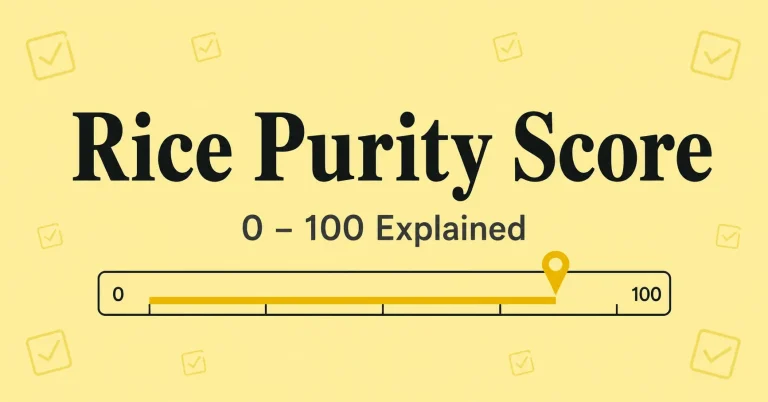
A Rice Purity Test score is a number between 0 and 100. Higher scores indicate fewer checked experiences. Lower scores indicate broader life experience across the surveyed categories. For a detailed explanation of score ranges, see Rice Purity Score Meaning.
Why do college students take the Rice Purity Test?
College students take the Rice Purity Test as a social bonding activity, a form of self-reflection, and a way to compare their experiences with peers. The tradition traces directly to the original orientation-week use at Rice University. For a full explanation, see What Is the Rice Purity Test.
Now that you know the complete history of the Rice Purity Test, see where your own score falls.
Take the Official Rice Purity Test →