How the Rice Purity Test Works
(Scoring, Questions & Results Explained)
The Rice Purity Test is a 100-question self-graded checklist that measures life experiences across 6 categories, producing a score from 0 to 100. Every checked experience subtracts one point from the starting score of 100. The lower the score, the broader the range of experiences a person has had.
What Is the Rice Purity Test?
The Rice Purity Test is an anonymous, self-reported checklist of 100 life experiences. It originated at Rice University in Houston, Texas, where students used it as a social icebreaker during freshman orientation.
The test covers 6 experience categories: romance, physical intimacy, alcohol and drug use, academic conduct, social behaviour, and criminal activity.
There are 4 core characteristics of the test:
- 100 questions — fixed, consistent, and identical for every user
- Anonymous — no account, login, or personal data required
- Self-graded — users check only the experiences that apply to them
- Scored 0–100 — higher scores indicate fewer checked experiences
The test is not a psychological assessment. It functions as a cultural benchmark and social conversation starter. To explore the full background, read What Is the Rice Purity Test?
How the Rice Purity Test Works
The Rice Purity Test follows a straightforward 6-step process. There are no timers, no trick questions, and no required answers.
- Open the test — Navigate to the test page. No registration is required.
- Read each statement — Each of the 100 statements describes a specific life experience.
- Check every experience that applies — Select the checkbox next to any experience you have had.
- Leave unchecked items blank — Do not select experiences you have not had.
- Submit the test — Click the submit or calculate button after reviewing all 100 items.
- Receive your score instantly — The result appears immediately on screen.
The process takes between 3 and 8 minutes for most users. There are no follow-up questions, no explanations required, and no minimum number of boxes to check.
How Rice Purity Scores Are Calculated
The Rice Purity Test uses a simple subtraction formula. Every checked experience removes exactly one point from the starting value of 100.
The Rice Purity Score Formula
This formula is consistent across all users. It does not weight experiences differently based on category or severity. Every item carries equal value.
Worked Examples
Rice Purity Score Table
| Checked Experiences | Final Score |
|---|---|
| 5 | 95 |
| 20 | 80 |
| 35 | 65 |
| 50 | 50 |
| 80 | 20 |
To understand what different score ranges indicate, read the full Rice Purity Score Meaning guide, which breaks down every score band in detail.
Ready to see how the scoring system works in practice?
Take the Rice Purity Test — Get Your Score InstantlyWhy Does the Test Have 100 Questions?
The Rice Purity Test has 100 questions for 3 practical reasons: scoring simplicity, experience coverage, and historical consistency.
- Scoring simplicity: A 100-question test produces a score that is immediately intuitive. Each checked item equals one lost point. Users do not need to perform any calculation.
- Experience coverage: 100 questions provide enough range to cover 6 distinct life experience categories without making the test exhausting to complete. Fewer questions would produce scores that cluster too closely together.
- Historical consistency: The original Rice University version used 100 questions. Subsequent versions maintained this structure to allow score comparisons across years and generations of test-takers.
The 100-question structure also creates a natural difficulty gradient. Early questions tend to describe common experiences. Later questions address progressively less common ones.
What Types of Questions Are Included?
The 100 questions span 6 experience categories. Questions within each category progress from mild to more serious experiences.
| Category | Description | Examples |
|---|---|---|
| Romance | Dating and relationship experiences | Holding hands, going on a date |
| Physical Intimacy | Physical contact and intimacy | Kissing, sleeping in the same bed |
| Alcohol & Drugs | Substance-related experiences | Drinking alcohol, marijuana use |
| Academic Conduct | School and university behaviour | Cheating on a test, plagiarism |
| Social Behaviour | Public and interpersonal situations | Skinny dipping, public embarrassment |
| Crime | Illegal or legally questionable activity | Vandalism, being arrested |
Questions are structured as statements rather than direct questions. A typical item reads: “Held hands romantically” or “Used tobacco products.” Users select any statement that accurately describes their personal history.
The sequence of questions is deliberate. Items describing common experiences appear early. Items describing rare or extreme experiences appear later. This progression prevents users from feeling judged from the first question.
Are All Questions Worth the Same?
Yes. Every checked experience removes exactly one point from the total score. There is no weighted scoring system in the Rice Purity Test.
Checking “held hands romantically” subtracts one point. Checking “been arrested” also subtracts one point. The formula does not differentiate between mild and serious experiences.
Why Equal Weighting Is Both a Strength and a Limitation
As a strength: Equal weighting keeps the scoring transparent and universally understandable. Any user calculates their score without additional information. The formula requires no knowledge of category weights, multipliers, or adjustment factors.
As a limitation: Equal weighting means the scoring system does not reflect real-world differences in experience significance. A person who has tried alcohol once and a person who has been arrested receive the same score reduction per item, despite the experiences being substantially different in scope.
This limitation is intentional. The test is designed for entertainment and social reflection, not clinical analysis. A weighted system introduces subjective judgements about which experiences matter more — an approach that contradicts the test’s neutral, self-reported design.
What Happens After You Finish the Test?
The score appears immediately after submission. There is no waiting period and no manual calculation required.
Here is what users receive after completing the test:
- A numerical score from 0 to 100
- Instant display on the same screen
- No email, no report, and no detailed category breakdown
The scoring process runs entirely within the browser. The page counts the number of checked boxes and applies the subtraction formula in real time. No external processing or server calculation is involved.
Some versions display score range descriptions alongside the numerical result. The Rice Purity Score Meaning guide explains these ranges in full detail.
Is Your Data Stored?
No personal data is stored when users take the Rice Purity Test. There are 4 key privacy characteristics of the test:
- No account required — users do not register or log in
- No personal information collected — no name, email, or age is requested
- No answer storage — individual responses are not saved to any database
- Browser-only calculation — the score is computed locally and not transmitted
The test does not know which specific boxes a user checks. It processes only the count of checked items to generate the score. Once a user closes the browser tab, no record of their responses or score is retained.
This design is fundamental to the test’s honesty-first philosophy. Users answer accurately, knowing their responses are entirely private.
Can You Retake the Rice Purity Test?
Yes. The Rice Purity Test has no retake limit. Users retake the test as many times as they choose.
There are 3 common reasons users retake the test:
- Tracking change over time — Many users take the test at 18, then again at 21 or 25, to observe how their score changes as they accumulate new experiences.
- Answering more honestly — Some users revisit the test after realising they misread or skipped certain questions during their first attempt.
- Comparing with friends — Groups often take the test together and compare results as a social activity.
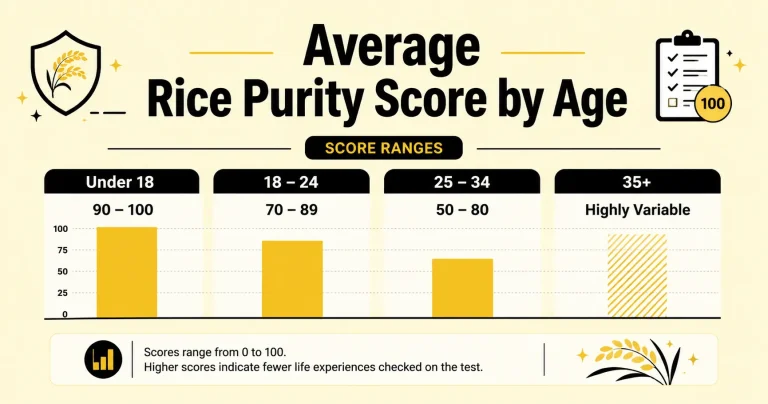
Score changes between retakes reflect genuine differences in life experience. A score that drops by 10 points between two retakes indicates that 10 additional items now apply. See how scores typically shift across different age groups in the Average Rice Purity Score by Age resource.
Common Mistakes People Make While Taking the Test
There are 5 frequent mistakes that affect the accuracy of Rice Purity Test scores.
- Misreading questions: Several questions use specific language. “Slept in the same bed as someone of the opposite sex” is not the same as “had a sexual relationship.” Reading each statement carefully prevents misclassification.
- Guessing or estimating: The test asks for confirmed personal experiences. Users who check items they are unsure about produce inaccurate scores. Leave the box unchecked if an experience is uncertain.
- Comparing scores competitively: The test measures personal history, not character. A score of 45 is not better or worse than a score of 82. Treating the test as a competition produces anxiety and distorts the purpose of the exercise.
- Treating the score as a psychological measurement: The test carries no clinical validity. It does not diagnose personality traits, predict behaviour, or assess mental health. The score reflects a count of experiences, nothing more.
- Rushing through questions: Completing the test in under two minutes increases the chance of misread questions and accidental selections. Taking 5 to 8 minutes to read each item carefully produces more accurate results.
Is the Rice Purity Test Scientifically Accurate?
No. The Rice Purity Test is not a scientifically validated instrument. It is designed for social entertainment and personal reflection.
There are 4 reasons the test lacks scientific accuracy:
- No clinical validation: The test has not been evaluated by psychologists or included in peer-reviewed research as a measurement tool.
- Equal weighting: Treating all experiences as equivalent removes any meaningful differentiation between minor and significant events.
- Self-reporting bias: Users may misremember, misread, or consciously misreport answers, introducing error that a validated instrument controls for.
- No standardised interpretation: Score ranges and their meanings vary between sources. No authoritative body has defined what each score range indicates.
The test functions as a cultural benchmark rather than a measurement tool. It creates a shared language for discussing life experiences without requiring personal disclosure. This purpose is valuable on its own terms, independent of scientific accuracy.
Frequently Asked Questions
How does the Rice Purity Test work?
The Rice Purity Test presents 100 statements describing life experiences. Users check every statement that applies to them. The final score equals 100 minus the total number of checked items.
How is the Rice Purity score calculated?
The score is calculated using one formula: Score = 100 − Number of Checked Experiences. Every checked item subtracts exactly one point. No weighting system is applied.
Why are there 100 questions?
The test uses 100 questions to create an intuitive scoring scale, provide broad coverage of 6 experience categories, and maintain consistency with the original Rice University format.
Are all questions worth the same?
Yes. Every checked question removes one point from the score regardless of the experience category or perceived seriousness of the item.
Can I change my answers?
Users modify their answers at any time before submitting the test. After submission, the only way to change answers is to retake the test from the beginning.
Is the Rice Purity Test anonymous?
Yes. The test requires no account, no personal information, and no login. Responses are not stored or transmitted. Scoring occurs entirely within the user’s browser.
Can I take it more than once?
Yes. The test has no retake limit. Users retake it as often as they choose, including to track score changes over time.
Now that you know how the Rice Purity Test works, how scores are calculated, and what the 100 questions cover — take the test and see where your score falls.
Take the Rice Purity Test — Free & Anonymous